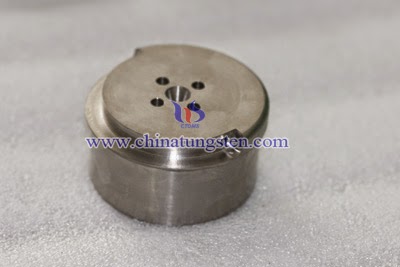
Most of the X-ray output of rotating anode
sources has a continuous energy range that extends up to a value, Emax that,
measured in electron volts, is equal to the acceleration voltage applied to the
tube.. This Bremsstrahlung ("braking radiation") arises from the
accelerations suffered by the electrons during collision with the atoms of the
anode, then that is the X-ray spectrum, superimposed on the Bremsstrahlung
background there are intense narrow line emissions that are characteristic of
the material of the anode. These characteristic lines are important for
crystallography but since they amount to only a few percent of the total X-ray
output they are of little radiological importance. For the radiation during
this whole process, tungsten alloy shielding will be the ideal material for
radiation protection, for more details, you could visit our website: http://www.tungsten-alloy.com/X-ray-target-collimator.htm.
2014-11-29
2014-10-31
The Energy of X-ray
All radiant energy, including X-ray, has
its origin in a disturbance of electrical charge. Consider a point charge — an
electron — surrounded by a symmetrical electromagnetic field and moving through
space at constant velocity. What happens to the motion of the field if the
central charge is speeded up or slowed down? Experiments indicate that the
field reacts much like a mass of jelly. When the central charge is accelerated,
the disturbance is communicated radially through the field as a wave motion —
the outside parts of the field requiring an appreciable time interval to catch
up with the center. Work expended in accelerating the central charge is carried
away by the wave as radiant energy, at a velocity which depends on the nature
of the “jelly.”
Tungsten alloy is a suitable material for
radiation protection, for more details, you could visit: http://www.tungsten-alloy.com/en/alloy07.htm.
X-ray Tungsten Alloy Radiation Protection for Bone Study
X-ray has a science function on bone study
in medical field, and it tends to flow through the skin and away from vital
organs such as the heart.
In this case, instead of filling with a
lavender glow, like the quartz bulb, the inside of the tungsten alloy tube
remained dark but the glass in contact with the magnesium lighted with a pale
greenish fluorescence that reminded me of the glow emitted by old style X-ray
tubes of the gas type, which is of tungsten alloy radiation protection.
Like visible light, X-rays are a form of
radiant energy. Exports have solved the problem of equipment cost. Protection
against exposure to the rays is not difficult to arrange. With these two
considerations out of the way, X-rays open a range of experiments equaled by
few other phenomena of physics. In addition to providing a source of X-rays for
radiographs, a generator of X-rays in combination with accessories enables you
to measure the charge of the electron, to study the structure of crystals, to
observe the wave-particle duality of matter and radiation, and to probe other
microcosmic corners. During this process, tungsten alloy material will be a
suitable material for radiation protection. For more details, you could visit http://www.tungsten-alloy.com/en/alloy07.htm.
The Substituation of Tungsten Plastic to Lead in Molded Products
There is a technique of tungsten plastic to
develop tungsten-filled plastics that can replace lead for radiation protection.
This technique has converted more than 50 lead-shielding parts with a
proprietary non-lead, polymer shielding material. Tungsten plastic technique is
more and more popular for radiation protection now. Lead may be the asbestos of
the 21 Century, but tungsten material superior in its high specific density and denser gravity. Medical device manufacturers in the United States also expect to face
stiff regulations on use of lead. Tungsten in a nylon 6 base offers equivalent
X-ray shielding and can be molded on standard equipment. However, as a new type
technique applied on tungsten plastic, the manufacture cost will be expensive
but it has an effective function to absorb radiation better than lead. For more details, you could visit http://www.tungsten-alloy.com/tungsten-plastic.html.
2014-09-23
What is X-ray Radiation?
X-ray radiation is characterized chiefly by
extremely short wavelength — about one ten-thousandth the length of visible
light waves. Like light waves, X-ray can be reflected, refracted, diffracted
and polarized. The techniques by which they are manipulated differ from those
employed with light, just as light techniques differ from those of radio. The
longest X-rays are indistinguishable from ultraviolet rays; the shortest are
identical with gamma rays. The distinction between the two is largely a matter
of definition. When the emission accompanies the disintegration of a
radioactive substance such as radium, it is called gamma radiation. Identical
waves generated by electronic means are called X-rays.
2014-09-22
What is X-ray Filter?- Was Röntgenfilter?
Monochromators and filters are used to
produce monochromatic x-ray light. This narrow wavelength range is essential
for diffraction calculations. For instance, a zirconium filter can be used to
cut out unwanted wavelengths from a molybdenum or tungsten alloy metal target.
The molybdenum or tungsten alloy target will produce x-rays with two
wavelengths. A zirconium filter can be used to absorb the unwanted emission
with wavelength Kβ, while allowing the desired wavelength, Kα to pass through.
Monochromatoren und Filter werden
verwendet, um monochromatische Röntgenlicht erzeugen. Diese schmalen
Wellenlängenbereich ist für die Beugungs Berechnungen. Zum Beispiel kann ein
Zirkonium-Filter verwendet werden, um sich unerwünschte Wellenlängen aus einer
Molybdän oder Wolfram-Legierung Metall-Target. Das Molybdän oder
Wolfram-Legierungstargets werden Röntgenstrahlen mit zwei Wellenlängen zu
erzeugen. Eine Zirkonium-Filter kann verwendet werden, um die unerwünschte
Emission mit der Wellenlänge Kß absorbieren, während es die gewünschte
Wellenlänge, Ka passieren.
Tungsten X-ray Tubes for Radiation Source
Tungsten x-ray tubes provide a means for
generating x-ray radiation in most analytical instruments.
An evacuated tube houses a tungsten alloymaterial which acts as a cathode opposite to a much larger, water cooled anode
made of copper with a metal plate on it. The metal plate can be made of any of
the following metals: tungsten, copper, cobalt and iron, etc.. A high voltage
is passed through the tungsten alloy material and high energy electrons are
produced. The machine needs some way of controlling the intensity and
wavelength of the resulting light. The intensity of the light can be controlled
by adjusting the amount of current passing through the filament; essentially
acting as a temperature control. The wavelength of the light is controlled by
setting the proper accelerating voltage of the electrons. The voltage placed
across the system will determine the energy of the electrons traveling towards
the anode.
X-rays radiation source is produced when the electrons hit
the target metal. Because the energy of light is inversely proportional to
wavelength (E=hc=h(1/λ), controlling the energy, controls the wavelength of the
x-ray beam.
订阅:
博文 (Atom)